A conference paper submission constitutes privileged communication. In theory, reviewers should immediately "forget" what they have read. How could a program committee member …
Many thanks for Cynthia Dwork's article "A Firm Foundation for Private Data Analysis" (Jan. 2011), explaining why, in trying to formalize what is perfect privacy, we cannot …
To ensure the timely publication of articles, Communications created the Virtual Extension (VE) to expand the page limitations of the print edition by bringing readers the same high-quality articles in an online-only format.
Data warehouses are not only increasing in size and complexity, but also in their importance to business. Michael Stonebraker shares 10 key ideas on the topic.
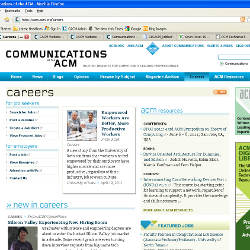
For the most coveted jobs and for organizations looking to hire experienced and talented workers, few online resources are more valuable than ACM's own Career and Job Center …
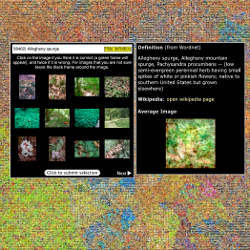
Teaching computers to understand pictures could lead to search engines capable of identifying and organizing large datasets of visual information.
With recent advances in laser rangefinders, faster algorithms, and open source robotic operating systems, researchers are increasing domestic robots' semantic and situational awareness.
Artificial intelligence and machine learning could expand access to health care, improve the quality of education, and respond effectively to natural disasters in the developing world.
Computational metaphysics is helping philosophers answer age-old questions, such as whether God exists.
A pair of divergent scientific communities discusses their similarities and differences, and search for common ground.
Studying how privacy regulation might impact economic activity on the advertising-supported Internet.
Rethinking the design of computer science courses and broadening the definition of computing education both on and off campus.
In early 1935, a man named Clarence Hickman had a secret machine, about six feet tall, standing in his office. Hickman was an engineer at Bell Labs, and his invention was, …
Steve Furber, designer of the seminal BBC Microcomputer System and the widely used ARM microprocessor, reflects on his career.
Highlighting the significance of the often overlooked underlying software used to produce research results.
Finding a lasting solution to the leap seconds problem has become increasingly urgent.
Web apps are cheaper to develop and deploy than native apps, but can they match the native user experience?
A Ruby on Rails app highlights some serious, yet easily avoided, security vulnerabilities.
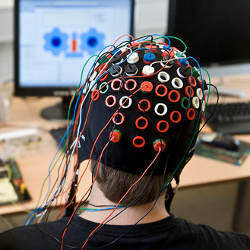
The brain's electrical signals enable people without muscle control to physically interact with the world.
Energy efficiency is the new fundamental limiter of processor performance, way beyond numbers of processors.
Privacy-preserving attribution of IP packets can help balance forensics with an individual's right to privacy.
Mobile advertising will become more pervasive and profitable, but not before addressing key technical and business challenges.
We became accustomed to acquiring software by procuring licenses for a proprietary, immaterial object. However, in recent years, this habit has begun to be …
Most of a computer scientist's production can go uncounted if a standard bibliographic service is used.
In contrast to popular belief, proving termination is not always impossible.
CDOs are examples of financial derivatives, with a value that depends on the underlying assets with which they are linked. …
Securitization of cash flows using financial derivatives transformed the financial industry over the last three decades. Derivatives have attracted criticism, but others say …
About 5,000 images per minute are uploaded to the photo-sharing site http://www.flickr.com/; over 7,000,000 a day. Such images often look …
The search for efficient image denoising methods is still a valid challenge at the crossing of functional analysis and statistics. In spite of the sophistication of the recently proposed methods, most algorithms have not yet …
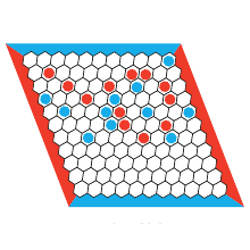
Welcome to three new puzzles. Solutions to the first two will be published next month; the third is (as yet) unsolved. In each, the issue is how your intuition matches up with the mathematics.