CACM logo

March 2009 (Vol. 52, No. 3)
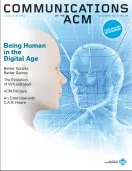
Being Human in the Digital Age

Table of Contents

DEPARTMENT: Editor's letter

"Yes, It Can Be Done"

The 2008 presidential campaign slogan "Yes, We Can" is the English translation of the United Farm Workers' 1972 slogan "Sí, se puede," or "Yes, it can be done."

Page 5

DEPARTMENT: Publisher's corner

DEPARTMENT: Letters to the editor

DEPARTMENT: CACM online

COLUMN: News

Betting on Ideas

Advanced computational models are enabling researchers to create increasingly sophisticated prediction markets.

Pages 13-15

Crowd Control

Researchers are turning to computers to help us take advantage of our own cognitive abilities and of the wisdom of crowds.

Pages 16-17

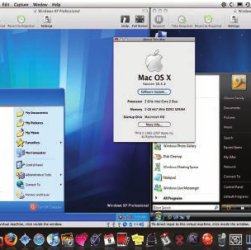
The Evolution of Virtualization

Virtualization is moving out of the data center and making inroads with mobile computing, security, and software delivery.

Pages 18-20

A Difficult, Unforgettable Idea

On the 40th anniversary of Douglas C. Engelbart's "The Mother of All Demos," computer scientists discuss the event's influence — and imagine what could have been.

Page 21

ACM Fellows Honored

Forty-four men and women are being inducted this year as 2008 ACM Fellows.

Page 22

COLUMN: Viewpoints

Is Software Engineering Engineering?

Software engineering continues to be dogged by claims it is not engineering. Adopting a computer-systems view that embraces hardware, software, and user environment may help.

Pages 24-26

When is a 'License' Really a Sale?

Can you resell software even if the package says you can't? What are the implications for copyright law of the U.S. Supreme Court's unanimous June 2008 decision in Quanta v. LG Electronics?

Pages 27-29

Your Students Are Your Legacy

This Viewpoint boils down into a few magazine pages what I've learned in my 32 years of mentoring Ph.D. students.

Pages 30-33

Advising Students for Success

Some advice for those doing the advising (and what the advisors can learn from the advisees).

Pages 34-37

An Interview With C.A.R. Hoare

C.A.R. Hoare, developer of the Quicksort algorithm and a lifelong contributor to the theory and design of programming languages, discusses the practical application of his theoretical ideas.

Pages 38-41

SECTION: Practice

Better Scripts, Better Games

Smarter, more powerful scripting languages will improve game performance while making gameplay development more efficient.

Pages 42-47

Erlang for Concurrent Programming

Designed for concurrency from the ground up, the Erlang language can be a valuable tool to help solve concurrent problems.

Pages 48-56

SECTION: Contributed articles

Reflecting Human Values in the Digital Age

HCI experts must broaden the field's scope and adopt new methods to be useful in 21st-century sociotechnical environments.

Pages 58-66

Statecharts in the Making: A Personal Account

How avionics work led to a graphical language for reactive systems where the diagrams themselves define the system's behavior.

Pages 67-75

SECTION: Review articles

Probabilistically Checkable Proofs

Can a proof be checked without reading it?

Pages 76-84

SECTION: Research highlights

Technical Perspective: The Beauty of Error-Correcting Codes

Error-correcting codes are the means by which we compensate for interference in communication, and are essential for the accurate transmission and storage of digital data.

Page 86

Error Correction Up to the Information-Theoretic Limit

Ever since the birth of coding theory almost 60 years ago, researchers have been pursuing the elusive goal of constructing the "best codes," whose encoding introduces the minimum possible redundancy for the level of noise they …

Pages 87-95

Technical Perspective: Where Biology Meets Computing

Alan Turing died in 1954 in his laboratory after eating a cyanide-laced apple. During his last years, Turing had become interested in bio-chemical systems. He had proposed a reaction-diffusion model in his 1952 paper entitled …

Page 96

Learning and Detecting Emergent Behavior in Networks of Cardiac Myocytes

We address the problem of specifying and detecting emergent behavior in networks of cardiac myocytes, spiral electric waves in particular, a precursor to atrial and ventricular fibrillation.

Pages 97-105

COLUMN: Last byte

Puzzled: Solutions and Sources

Last month (February 2009, p. 104) we posed a trio of brain teasers concerning algorithm termination. Here, we offer some possible solutions. How did you do?

Page 111

Future Tense: Radical Evolution

In 1913, the U.S. Government prosecuted Lee De Forest for telling investors that RCA would soon be able to transmit the human voice across the Atlantic. What similarly preposterous claims are enabled by today's technology?

Pages 112-ff

SECTION: Virtual extension

Digital Inclusion With the McInternet: would you like fries with that?

Should corporations try to "do good" for society?

Pages 113-116

A New Map for Knowledge Dissemination Channels

The landscape for Information Systems (IS) research spreads across a large, diverse, and growing territory with linkages to other fields and traversed by increasing numbers of researchers. There are well over 500 journals for …

Pages 117-125

Online Privacy Practices in Higher Education: making the grade?

In June 2006, the trustees of Ohio University (OU) voted unanimously to spend up to $4 million on enhanced information security. The decision came in the wake of the media coverage about OU's "lax, low-priority attitude toward …

Pages 126-130

Ensuring Transparency in Computational Modeling

Computational models are of great scientific and societal importance because they are used every day in a wide variety of products and policies. However, computational models are not pure abstractions, but rather they are tools …

Pages 131-134

Open Access Publishing in Science

While the evolving information society is freely opening and sharing its diaries, social networks and source codes, it remains to be seen if the same will come true for scientific knowledge. Despite strong sympathy for the idea …

Pages 135-139

Who Captures Value in a Global Innovation Network?: the case of Apple's iPod

Innovation is often touted as a key driver of economic growth. However, when firms operate within production and innovation networks that span national and firm boundaries, the question arises as to who actually benefits from …

Pages 140-144

Concept Similarity By Evaluating Information Contents and Feature Vectors: a combined approach

Evaluating semantic similarity of concepts is a problem that has been extensively investigated in the literature in different areas, such as Artificial Intelligence, Cognitive Science, Databases, and Software Engineering. Currently …

Pages 145-149

Technical Opinion: Security Threats of Smart Phones and Bluetooth

In a recent security experiment, a computer with a Bluetooth sniffing program was hidden in a suitcase that was wheeled around public places. The objective was to ascertain the number of Bluetooth-enabled mobile devices that …

Pages 150-152

About Communications | Join ACM External Link | Renew External Link | Subscribe External Link | Sign In | For Authors | For Advertisers External Link | Privacy | Site Map | Help | Contact Us | Mobile Site

Copyright © 2012 by the ACM. All rights reserved.