
Beyond Human-Computer Interaction (HCI) researchers, scientists from diverse fields such as Computer-Supported Cooperative Work (CSCW), WWW research, Hypertext, Digital Libraries conferences are feeling the impact of Social Web systems and are publishing research papers that characterize, model, prototype, and evaluate such systems.
Moreover, studies from behavioral microeconomics, organizational economics, sociology, ethnography, social network analysis, information flow analysis, political science, and conflict resolution are potentially relevant to Social Web researchers. Researchers are seeing a surge of new research on Web2.0 technologies distributed in a wide variety of disciplines and associated conferences.
Here is a figure that describes a way to think about these systems. Going from the left to right is going from light-weight to heavy-weight collaboration systems. Various social systems are laid out on a collaboration spectrum. Some are heavyweight collaboration systems that require users to coordinate and resolve conflicts with each other, while other systems are collective averaging systems in which users simply vote on items of interest.
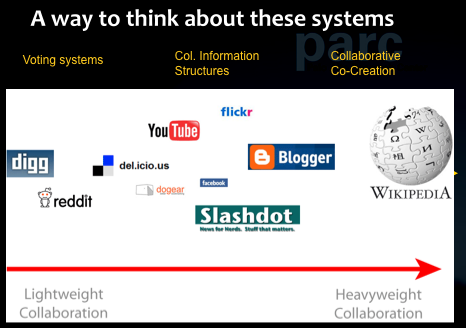
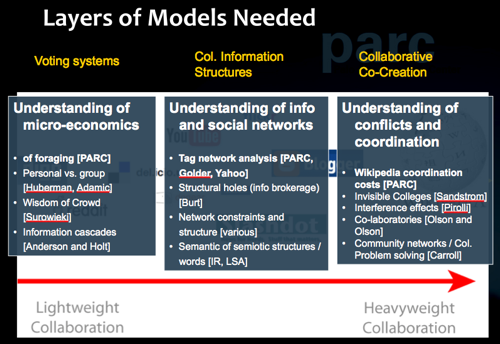
- At the light-end of collaboration spectrum, we have researchers trying to understand the micro-economics of voting systems, of individual and social information foraging behaviors, processes that govern information cascade, and wisdom-of-the-crowd effects. HCI researchers have productively studied information foraging and behavioral models in the past, and are trying to apply them in the new social context on the Web. Economists are trying to understand peer production systems, new business models, and consumption and production markets based on intrinsic motivations.
- At the middle of the collaboration spectrum, researchers are building algorithms that mine new socially constructed knowledge structures and social networks. Here physicists and social scientists are using network theories and algorithms to model, mine, and understand these processes. Algorithms for identifying expertise and information brokers are being devised and tested by information scientists.
- At the heavy-end of the collaboration spectrum, the understanding of coordination and conflict costs are especially important for collaborative co-creation systems such as Wikipedia. Researchers had studied characteristics that enable groups of people to solve problems together or collaborate on scientific endeavors. Discoveries such as the identification of “invisible colleges” by P. Sandstrom have shown that implicit coordination can be studied and characterized.
To sum it up, Web2.0 isn’t just a fad, but a fundamental transformation of the Web into a true collaborative and social platform. The research opportunity is to fully understand how to enhance the ability of a group of people to remember, think, and reason.


Join the Discussion (0)
Become a Member or Sign In to Post a Comment