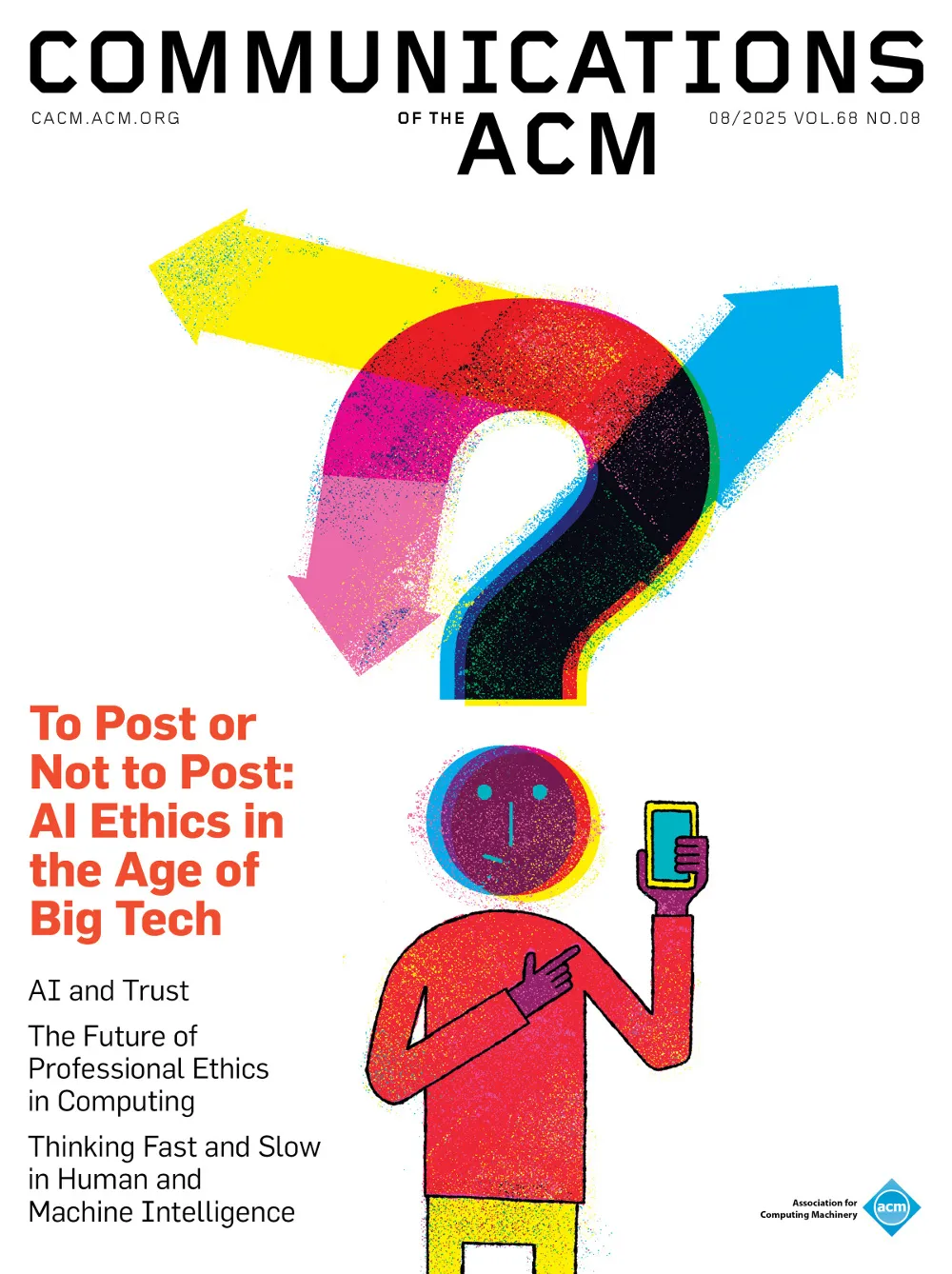
CACM logo

March 2010 (Vol. 53, No. 3)

Table of Contents

Revisiting the Publication Culture in Computing Research

In my May 2009 Editor's Letter, "Conferences vs. Journals in Computing Research," I addressed the publication culture of our field: "As far as I know, we are the only scientific …

Page 5

DEPARTMENT: Letters to the Editor

Too Much Debate?

In his editor's letter "More Debate, Please!" (Jan. 2010), Moshe Y. Vardi made a plea for controversial topics on these pages, citing a desire to "let truth emerge from vigorous …

Pages 6-7

In the Virtual Extension

Communications' Virtual Extension brings more quality articles to ACM members. These articles are now available in the ACM Digital Library.

Page 8

DEPARTMENT: BLOG@CACM

Too Much Programming Too Soon?

Mark Guzdial and Judy Robertson discuss the role of programming in introductory computer science.

Pages 10-11

DEPARTMENT: CACM online

Granting a Second Life

Almost 90% of what we learn comes from reading, estimates say, and the path that online information takes to your brain is less direct than most. TheCommunications Web site …

Page 12

COLUMN: News

CS and Biology's Growing Pains

Biologists can benefit from learning and using the tools of computer science, but several real-world obstacles remain.

Pages 13-15

Engineering the Web's Third Decade

As Web technologies move beyond two-way interactive capabilities to facilitate more dynamic and pervasive experiences, the Web is quickly advancing toward its third major upgrade.

Pages 16-18

Tracking garbage

Researchers are focusing on the so-called "removal chain" in an attempt to save landfill space, improve recycling rates, and trim the flow of toxic materials into the environment.

Pages 19-20

Katayanagi Prizes and Other CS Awards

Donald E. Knuth, Jon Kleinberg, Andrew Herbert, and other members of the computer science community were recently honored for their innovative research and service.

Page 21

COLUMN: Economic and business dimensions

Gaming Will Save Us All

How gaming, as the first media market to successfully transition toward media-as-a-service, is an exemplar for a similar evolutionary transition of content and entertainment.

Pages 22-24

COLUMN: Legally speaking

Only Technological Processes Are Patentable

The U.S. Supreme Court will narrow the universe of process innovations that can be patented to those that are "technological," but what will that mean for software?

Pages 25-27

COLUMN: Computing ethics

The Ethics Beat

Surveying the increasing variety and nature of ethical challenges encountered by computing researchers and practitioners.

Pages 28-29

COLUMN: The profession of IT

Orchestrating Coordination in Pluralistic Networks

Learning to build virtual teams of people of diverse backgrounds is an urgent challenge.

Pages 30-32

COLUMN: Broadening participation

Hiring and Developing Minority Faculty at Research Universities

Emphasizing the importance of creating more programs and investing more funding toward the goal of developing minority faculty at research universities.

Pages 33-35

COLUMN: IT policy

Making the Case for Computing

Seeking funding for current and future computing initiatives requires both a strong argument and a broad community of supporters.

Pages 36-38

COLUMN: Viewpoint

Privacy on the Data Web

Considering the nebulous question of ownership in the virtual realm.

Pages 39-41

SECTION: Practice

GFS: Evolution on Fast-Forward

Kirk McKusick and Sean Quinlan discuss the origin and evolution of the Google File System.

Pages 42-49

Toward Energy-Efficient Computing

What will it take to make server-side computing more energy efficient?

Pages 50-58

Global IT Management: Structuring for Scale, Responsiveness, and Innovation

To succeed on a global scale, businesses should focus on a trio of key elements.

Pages 59-64

SECTION: Contributed articles

Chasing the AIDS Virus

With no HIV vaccine in sight, virologists need to know how the virus will react to a given combination drug therapy.

Pages 66-74

Virtual Computing Initiative at a Small Public University

Student participation and resulting expertise is as valuable as having the high-performance resource itself.

Pages 75-83

SECTION: Review article

Making Decisions Based on the Preferences of Multiple Agents

Computer scientists have made great strides in how decision-making mechanisms are used.

Pages 84-94

SECTION: Research highlights

Technical Perspective: A First Glimpse of Cryptography's Holy Grail

We all know how to protect our private or most valuable data from unauthorized access: encrypt it. Still, the use of encryption to protect valuable or sensitive data can be …

Page 96

Computing Arbitrary Functions of Encrypted Data

Suppose that you want to delegate the ability to process your data, without giving away access to it. This separation is possible: we describe a "fully homomorphic" encryption scheme that keeps data private, but that allows a …

Pages 97-105

Technical Perspective: Seeing the Trees, the Forest, and Much More

Bristling with cameras, microphones, and other sensors, today's portable phones are nevertheless essentially deaf and blind. How shall we go about building machines that can …

Page 106

Using the Forest to See the Trees: Exploiting Context for Visual Object Detection and Localization

Recognizing objects in images is an active area of research in computer vision. However, most of the algorithms for detecting objects perform an exhaustive search across all locations and scales in the image comparing local image …

Pages 107-114

COLUMN: Last byte

Puzzled: Solutions and Sources

Last month (February 2010, p. 120) we posted a trio of brainteasers, including one as yet unsolved, concerning the breaking of a bar of chocolate.

Page 118

Future Tense: The Primal Cue

Future Tense, one of the revolving features on this page, presents stories and essays from the intersection of computational science and technological speculation, their boundaries limited only by our ability to imagine what

 …
Pages 120-ff

SECTION: Virtual extension

Business Continuity and the Banking Industry

There is renewed interest in emergency planning in both the private and public sectors. As managers realize the size of potential exposure to unmanaged risk, insuring "business continuity" is becoming a key task within all industrial …

Pages 121-125

A Framework for Health Care Information Assurance Policy and Compliance

As many as 400 people may have access to one's personal medical information throughout the typical care process. Patients (consumers) feel that it is critical that their medical information is held in confidence, otherwise they …

Pages 126-131

Is Stickiness Profitable for Electronic Retailers?

Is stickiness the Holy Grail for e-tailing? The conventional wisdom suggests that stickiness is crucial and can contribute to e-tailers' bottom lines considerably. However, the direct economic impacts of stickiness have not been …

Pages 132-136

User Participation in Software Development Projects

A recent industry survey observed that only 34% of IT projects were considered successful. Of the several potential factors contributing to this hard-to-achieve success, user involvement was noted as the most important one.

Pages 137-141

Practitioner-Based Measurement: A Collaborative Approach

The established philosophy within the software development industry is that an organization implementing a program to improve software quality can expect to recoup the cost of the implementation many times over. While organizations …

Pages 142-147

Organizational Adoption of Open Source Software: Barriers and Remedies

Perhaps the business case for adopting open source software is an easy sell. Less obvious than the cost savings but equally important are the barriers ("hidden costs") of adopting open source software.

Pages 148-151

Aligning Undergraduate IS Curricula With Industry Needs

A paradox is becoming obvious to both information systems (IS) academics and executives: U.S. demand for IS graduates is increasing, but graduation numbers from university IS programs are flat or in decline, and many CIOs report …

Pages 152-156

Agent-Oriented Embedded Electronic Measuring Systems

Agent-based systems, or multi-agent systems in general, are a contemporary paradigm for software development.

Pages 157-162

About Communications | Join ACM External Link | Renew External Link | Subscribe External Link | Sign In | For Authors | For Advertisers External Link | Privacy | Site Map | Help | Contact Us | Mobile Site

Copyright © 2012 by the ACM. All rights reserved.